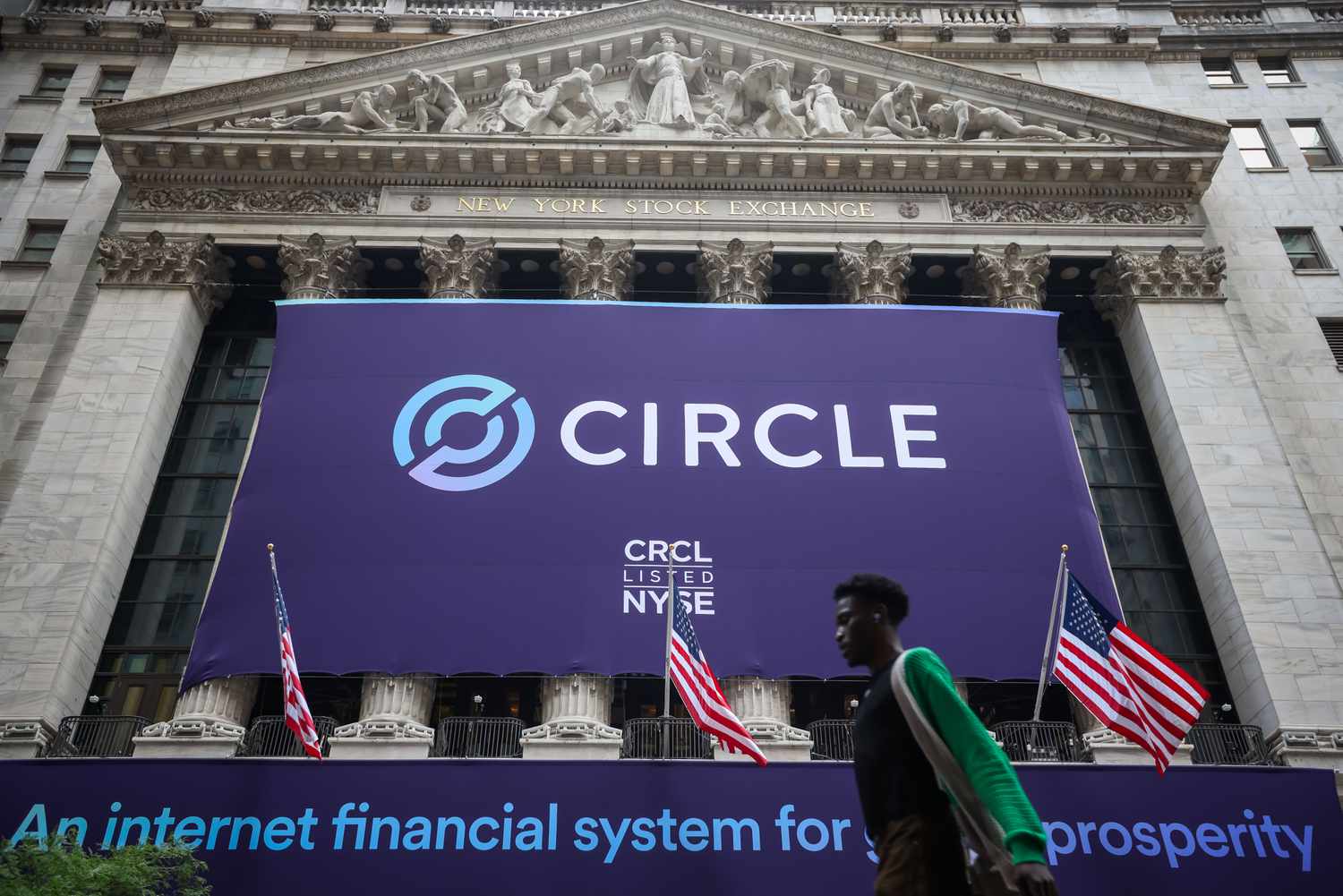
Can Circle be the Visa of the AI era?
Payments are shifting from human-only to human-plus-machine
The man who built PayPal has built a payment app again, twenty-five years later. This time it isn’t aimed at people.
Elon Musk’s X Money’s public beta opened on April 26th. The feature list reads like a Venmo killer: 6% yield, 3% cashback, 0% FX fees, free P2P transfers, FDIC coverage up to $250,000 through Cross River Bank, and Visa Direct rails for instant funding and withdrawals. Money-transmitter licenses — the state-by-state slog that usually takes fintechs three to five years — have already been quietly secured in 41 states. On top of that sits a 600-million-user distribution layer.
The obvious read is that Musk is coming for PayPal, Venmo, and Cash App. The obvious read is wrong.
Three competing narratives have circulated since the launch, and none of them survive contact with Musk’s actual track record. As a Venmo competitor, X Money walks into a saturated, habitual market. Venmo has ~90M users, Cash App ~50M, switching is rare, and a 6% yield more than 5x a normal deposit account immediately drew a Senator Warren letter asking how a non-bank can pay bank-illegal interest. More fatally, the thesis can’t explain a 25-year arc. Buying Twitter for $44B to ship a better Venmo is not coherent capital allocation. As an American super app, X Money is up against a graveyard: Meta’s Diem was wound down in 2022, WhatsApp Pay never gained traction, PayPal’s super-app push collapsed back into a payments product. Individualist consumer culture, 50-state regulatory fragmentation, and low public trust in Big Tech keep killing the WeChat model in the US, and Musk knows that history. As a USDC integration, it would solve cross-border remittance overnight, but it would also make X dependent on Circle’s policy and reserves. Musk’s pattern is to own infrastructure, not rent it. Tesla buys battery companies. SpaceX builds its own satellites. X runs its own ad stack. As a private stablecoin (XUSD or X Coin), it fits Musk’s style and fits the GENIUS Act’s late-stage carve-out for non-financial issuers, but PayPal already ran that experiment. PYUSD has 400M potential users and still sits at roughly 4% of USDC. A stablecoin without external usage locations is just an internal balance with extra steps.
So none of the standard interpretations explain why Musk is doing this, why now, or why he’s been holding the X.com domain since 1999.
In March of that year, Musk put $12M of his own money into X.com, pitched as the place where every form of finance lived on the internet. By 2000 it had merged with Confinity, been renamed PayPal, and pushed Musk out of the CEO seat while he was on his honeymoon. He bought the X.com domain back from PayPal in 2017, acquired Twitter in 2022, renamed it X in 2023, and has now launched X Money on top of it. The original 1999 vision wasn’t wrong. It was early. In 1999, the only entity that could initiate a payment was a human. Internet banking just made human payments more convenient. PayPal was what was possible given that constraint.
The constraint is gone.
In July 2025, Trump signed the GENIUS Act, the first US federal stablecoin framework. The intended scope was banks, bank subsidiaries, and licensed fintechs. A late-stage clause widened it to non-financial issuers — tech companies — under defined conditions. Senator Warren publicly called this a “carve-out” and pointed at the timing: Musk was inside the White House as a Special Government Employee while the bill was being negotiated. In April 2026 she sent him thirteen questions, one asking directly whether he was involved.
Now run that alongside the rest of his portfolio. xAI’s Grok is a reasoning agent embedded directly inside X. Tesla’s Optimus is scheduled for full mass production in 2026. The Cybercab is a driverless vehicle that charges and parks itself. Starlink owns global connectivity. Neuralink is a brain-machine interface. The pattern is not “Musk owns AI plus robots plus cars.” Every one of these assets is an autonomous economic actor. Optimus needs to order parts. A Robotaxi needs to pay for charging. Grok needs to settle API calls. None of them have a human typing in a CVV.
Seen this way, X Money is not a P2P app. It is the wallet layer for the autonomous assets Musk is simultaneously building. The 87-year-old Captain Kirk fronting the launch is not a casting accident. Star Trek is the cultural shorthand for a future of automated systems, and the branding is doing exactly the work the product is doing. What Musk has spent twenty-five years assembling is autonomous-agent infrastructure with a wallet attached.
If payments are shifting from human-only to human-plus-machine, the strategically interesting question is no longer who builds the wallet. It is which digital dollar the wallet settles in. Musk is busy manufacturing the payers. The asset those payers actually transact in is being decided right now, and the decision is mostly already made.
Why Circle becomes the Visa of the AI era
A year ago, the consensus was that USDC was about to lose. In April 2025, Coinbase zeroed out trading fees on PayPal’s PYUSD, then sitting at $870M in market cap, and analysts argued that PayPal’s 439M active accounts and $1.79T in 2025 payment volume would steamroll Circle. A month later, Reuters reported that JPMorgan, Bank of America, Citi, and Wells Fargo were exploring a joint bank-issued stablecoin. The narrative wrote itself: a no-brand 80-billion-dollar token couldn’t survive PayPal’s distribution and the banks’ brands.
The Q4 2025 scoreboard says the opposite. USDC supply is $75.3B, up 72% year-over-year. On-chain transaction volume across Q4 and Q1 came in at $11.9T, up 247%. PYUSD did grow — to $3.43B — but USDC’s market cap is now $77.6B. PYUSD is roughly 4.4% of USDC.
The reason is a category error in how most people read stablecoins. Power is not measured in users. It is measured in usage locations, the venues, protocols, and standards that name a specific stablecoin as their settlement asset. PayPal has wallets. USDC has the market. PYUSD inside a PayPal account is a feature. Users already have a dollar balance there and have no reason to convert into a token that only spends inside the same app. USDC, by contrast, is the default settlement asset across exchanges, DeFi protocols, fintechs, institutional networks, and emerging payment standards. The market that already missed this can be seen in three places.
The first is on-chain derivatives. Hyperliquid holds roughly 70% of the on-chain perpetual-futures market, with 30-day trading volume above $180B. DYDX, in second place, runs at 10-12% of that. Hyperliquid’s documentation makes the rule explicit: contracts are quoted in USDT, but the only acceptable margin asset is USDC. Even after Hyperliquid launched its own USDH stablecoin last year, more than 90% of deposits remain in USDC. Tether’s market cap is roughly twice USDC’s. In the venue that defines on-chain leverage, Tether is structurally locked out.
The second is prediction markets. Polymarket has been USDC-only on Polygon since 2020. Monthly trading volume went from ~$2B in March 2025 to $26.75B in January 2026, a roughly 13x expansion in a year. In October 2025, ICE, the parent of the New York Stock Exchange, committed up to $2B in strategic investment at an $8B valuation. The most conservative actor in traditional finance just put real capital into a USDC-denominated venue. Polymarket’s own new settlement token, PUSD, is backed 1:1 by USDC. It deepens the dependency rather than replacing it.
The third is AI agent payments. HTTP has had a status code reserved for machine-to-machine payments, 402 Payment Required, since the 1990s. It sat empty for thirty years because there was no standard to fill it. In September 2025, Coinbase and Cloudflare shipped X402: when an agent calls an API and receives a 402, it pulls funds from its wallet and retries the request automatically. No human in the loop. In 2026, governance moved under the Linux Foundation as the X402 Foundation, with Cloudflare and Stripe as governing members. Stripe integrated X402 USDC payments natively into its API on Base. Google’s agent payment protocol AP2 adopts X402 as the default stablecoin rail. The standard is technically chain-agnostic, but in practice it is USDC-only. Gasless transfers via EIP-3009, which make sub-cent payments economic, are supported overwhelmingly by USDC, and Circle’s own chain, Arc, adds Nano Payments down to one one-hundredth of a cent. The settlement asset for the agent economy is being defined into existence around USDC.
None of these are small markets. On-chain derivatives, prediction markets, and AI agent payments are three of the likeliest centers of gravity for crypto and internet payments over the next decade. In all three, USDC is the only asset accepted at the door.
What sits behind that door has also outgrown the word “stablecoin.” USDC is backed 1:1 by cash and cash equivalents, with most reserves in the BlackRock-managed Circle Reserve Fund and a daily report. CCTP moves it natively across blockchains 1:1, so USDC on Ethereum becomes USDC on Solana without bridge wrappers and liquidity does not fragment. The Circle Payments Network has 55 financial institutions live and 74 under review, running at roughly $5.7B annualized. Visa now allows US merchants and issuers to settle directly with Visa using USDC. What this adds up to is not a coin. It is a digital-dollar API.
The deeper moat is sixty years old. In 1958, Bank of America launched BankAmericard, the ancestor of the Visa card. From 1966 onward, BofA licensed the system out to other banks. Member banks immediately resented it: the rails, fees, and brand were controlled by a single competitor. By 1970 the politics were unworkable, and BofA spun the network out into a member-owned cooperative, which would later be renamed Visa. Mastercard was structured as a bank consortium from inception in 1966. The lesson is binding: a payment standard cannot be owned by a participant. Other players will not route their customers and capital through infrastructure that is also their competitor.
That is the wall every non-Circle stablecoin runs into. PYUSD is controlled by PayPal. No serious fintech wants its core settlement to depend on a competing payment app. JPMD is controlled by JPMorgan. Citi and Bank of America have no interest in routing through it. The four-bank joint stablecoin is still conceptual a year after the Reuters report, for the obvious reason: nobody can agree on who controls governance. Circle has no payment app, no exchange, and no bank. Adopting USDC does not put Circle in competition with the adopter’s core business. That structural neutrality, not the technology and not the brand, is the moat.
Two shifts are converging. The payer is becoming a machine. The rail is becoming a neutral digital-dollar network. Musk is building the payers and the wallet that holds their balances. Circle is building the rail those balances actually settle on. Whether X Money individually wins or fails is not the trade. The trade is the regime change underneath it: a payment system designed for seventy years around a human entering a card number is being replaced by one designed around autonomous agents transacting at machine speed. In the credit-card era, Visa won by being the neutral standard everyone could route through without arming a competitor. In the stablecoin era, that role is open exactly once, and USDC has already taken it.